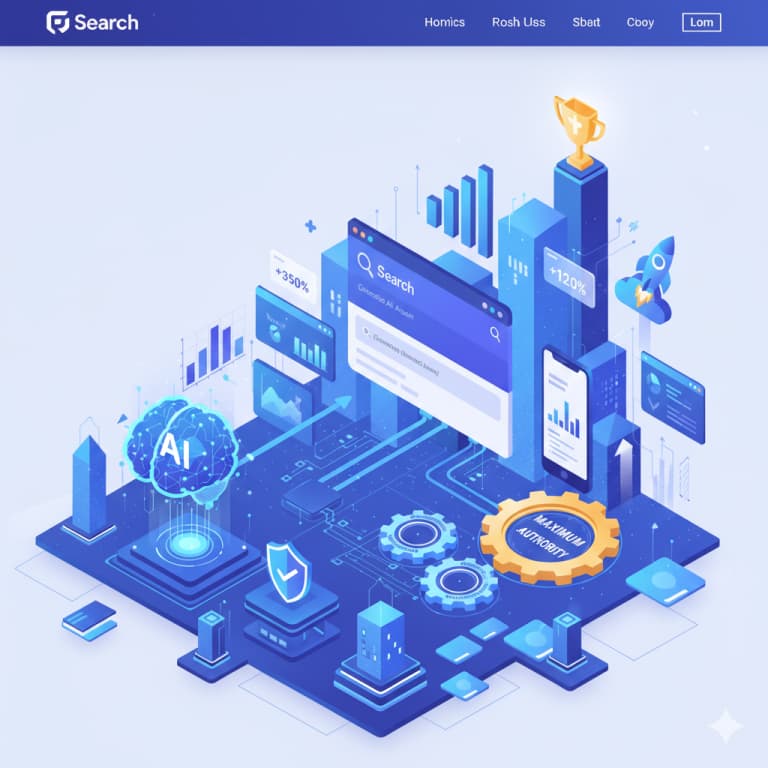
The definition of "being found" has changed forever. For decades, SEO was about making Google understand your website. Today, a new player has entered the field: AI-driven search. Positioning your brand in 2026 requires a dual-track strategy.
While SEO ensures you appear in traditional search results, AISEO ensures you are the "recommended answer" when a user asks a chatbot or assistant for a solution.
"AISEO doesn't replace SEO; it layers on top of it. Technical authority fuels AI trust."
Goal: From keyword density to entity-based authority.
Strategy Overview
The Pillars of Modern Positioning
Traditional SEO: The Foundation
Classic SEO is still the engine. Technical health and backlink authority remain the 'entry price' to compete in 2026.
Strategy
- Core Web Vitals: Mobile speed and stability are non-negotiable for rankings.
- Topic Clusters: Organize content into hubs to demonstrate depth in your niche.
- High-Quality Backlinks: One tier-1 industry link is worth 1,000 spammy directories.
Avoid
Ignoring technical debt or poor site architecture while chasing AI trends.
AISEO: Optimizing for the Answer Engine
AISEO focuses on how LLMs perceive your brand. You are no longer ranking for a link; you are ranking for a citation.
Strategy
- Schema Markup: Use advanced JSON-LD to help AI understand your 'entities'.
- NLP Alignment: Write in a natural, direct way that AI can easily summarize.
- Brand Citations: Build reputation in podcasts and forums where AI 'learns'.
Avoid
Using flowery prose that confuses AI parsers and reduces citation chances.
Information Gain & Unique Data
Google now rewards 'Information Gain'. If your content doesn't add something new, it will be treated as invisible noise.
Strategy
- Proprietary Data: Publish original surveys, case studies, or experiment results.
- Expert Perspectives: Include 'hot takes' from real human experts in your field.
- Rich Media: Use custom diagrams that explain concepts better than text alone.
Avoid
Summarizing page 1 of Google. Rehashed content is dead to modern algorithms.
The Zero-Click Content Shift
SGE provides answers directly on the SERP. Capture brand awareness even when users don't click through.
Strategy
- Position Zero: Optimize for snippets with clear 40-50 word definitions.
- Visual Search: Optimize images for Google Lens and visual discovery agents.
- Actionable Headers: Ensure H2s provide value even if someone only skims.
Avoid
Hiding valuable answers at the bottom of a 3,000-word post.
SEO vs. AISEO: Key Differences
| Feature | Traditional SEO | AISEO (LLM Opt.) |
|---|---|---|
| Objective | Rank in top 10 blue links | Definitive cited answer |
| Metric | CTR & Impressions | Sentiment & Citation Share |
| Content | Keyword articles | Structured data & insights |
| Intent | Search / Browse | Conversational / Query |
The Future of Digital Real Estate
Your Hybrid Action Plan
- Implement Advanced Schema: Go beyond basic articles to Service and FAQ JSON-LD.
- Audit for 'Information Gain': Add unique expert commentary to top pages.
- Monitor AI Citations: Track brand mentions in Gemini/ChatGPT results.
SEO & AISEO FAQs
Will AISEO make traditional SEO obsolete?
No. AI models use the web index to learn. If your traditional SEO is poor, AI agents will never find you to use you as a trusted source.
How do I optimize for Google's SGE?
Focus on precision. Use structured answers early in the text, bullet points, and ensure high E-E-A-T signals in your niche.
What's the difference between ranking and being cited by AI?
Ranking is appearing in position 1-10 of search results. Being cited means your content is used as a source in AI-generated answers. Citations drive higher-quality traffic and brand authority.
Should I change my content strategy immediately?
Start by auditing your Technical SEO foundation. AISEO layers on top of traditional SEO, so fix Core Web Vitals and backlink quality first. Then add AI-specific optimizations like Schema markup and NLP alignment.
How do I measure AISEO success?
Track: (1) AI citations in Google results, (2) traffic quality from SGE traffic, (3) brand mentions in LLM outputs. Use tools like Semrush or Ahrefs to monitor your SERP changes and citation trends.
Put the insight into action
Ready to turn this idea into a growth plan?
Tell us what you are working toward and we will help you identify the clearest next step for your business.